May 16, 2026 · ForeclosedBahay Editorial
How to Inspect a Foreclosed Property Properly
Ready to find your next property to inspect? Browse hundreds of bank foreclosed property listings from BDO, BPI, Metrobank, PNB, and more at — the bank takes no responsibility for repairs or hidden defects. What you see is what you get. And sometimes, what you don't see will cost you a lot of money.
Here's how to inspect a foreclosed property properly in the Philippines, and what to look for before you put your money down.
Step 1: Request a Viewing Schedule from the Bank
You need to actually get inside the property first. Banks like BDO, BPI, Metrobank, PNB, and Security Bank all have Asset Management units that handle their foreclosed inventories. Contact them directly to schedule a viewing. Some banks allow walk-in inspections during open house events, while others require you to coordinate with an assigned officer or accredited broker.
Don't skip the formal request process. Showing up unannounced at a foreclosed property — especially one still occupied by former owners or informal settlers — can lead to uncomfortable and even dangerous situations. Always go through official channels.
Step 2: Bring the Right People With You
Don't inspect a property alone, especially if you're not a construction professional. Bring at least one of the following:
- A licensed civil engineer or architect — They can assess structural integrity, spot water damage, and estimate repair costs.
- A trusted contractor — Someone who can give you a realistic figure on rehabilitation expenses.
- A real estate broker — An accredited PRC broker familiar with the area can tell you whether the asking price still makes sense after factoring in repairs.
Yes, you may need to pay for their time. But that professional fee is nothing compared to buying a property with a cracked foundation or an electrical system that's a fire waiting to happen.
Step 3: Use a Property Inspection Checklist
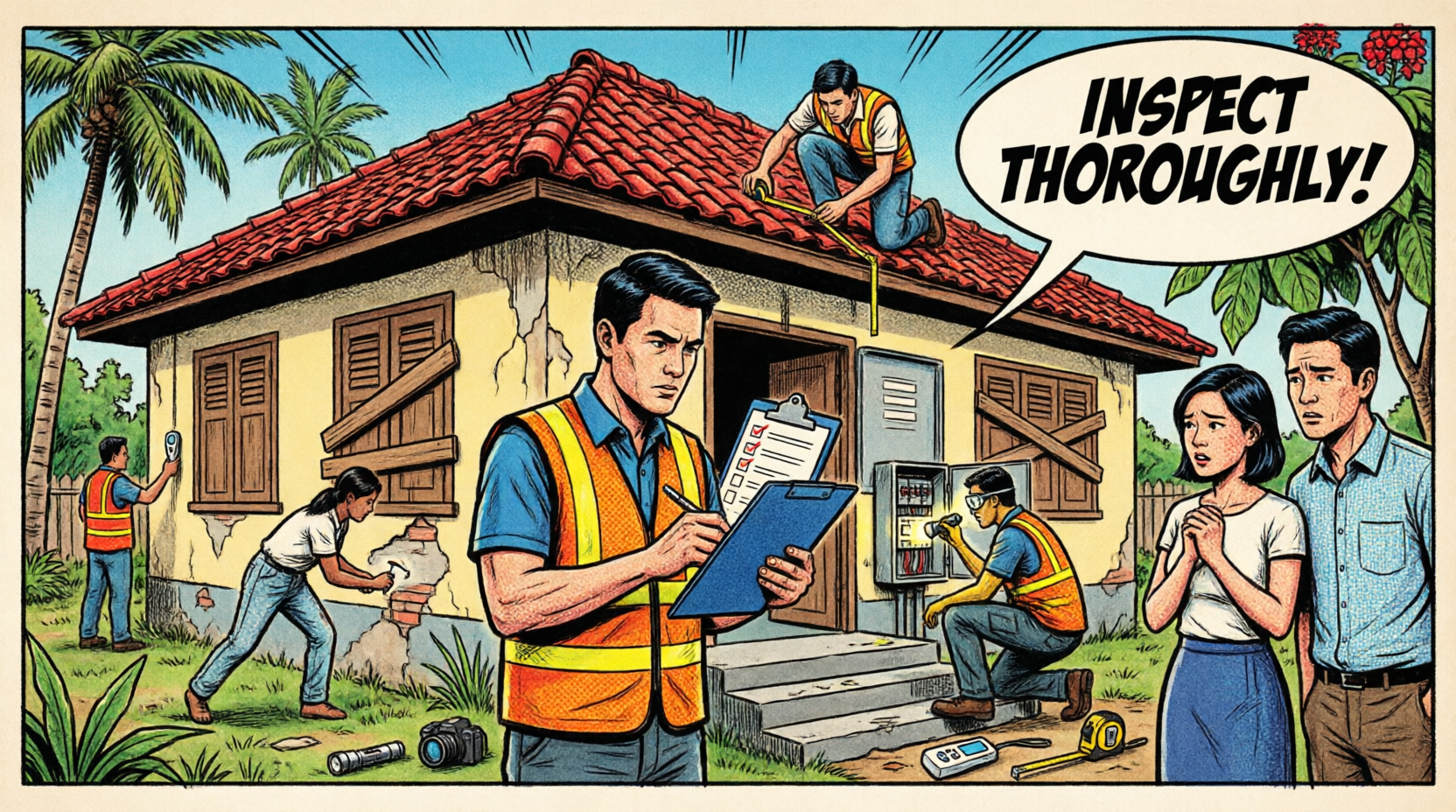
Walking through a property without a property inspection checklist is like grocery shopping while hungry and without a list — you'll miss important things and regret it later. Here's what your checklist should cover when you inspect a foreclosed property in the Philippines:
Structural and Foundation
- Check walls and ceilings for cracks, especially diagonal or stair-step cracks, which may point to foundation movement
- Look for uneven floors — bring a marble or a simple level tool
- Inspect columns and beams for visible damage or spalling concrete
- Check if the property has flooded before — water stain marks on walls are a clear sign
Roof and Ceiling
- Look for rust on GI sheets or missing roofing panels
- Check for water stains on ceilings, which point to leaks during rainy season
- Inspect the fascia boards and gutters for rotting or damage
Plumbing and Water
- Turn on faucets to check water pressure — low pressure may mean clogged pipes or bigger problems
- Flush toilets to see if they drain properly
- Look under sinks for signs of water damage or mold
- Ask if the property is connected to a water district (MWSS, Maynilad, Manila Water) or depends on a deep well
Electrical System
- Check if the electrical meter is still present — some foreclosed properties have had their meters removed
- Look at the circuit breaker panel for signs of overloading, illegal connections, or outdated ceramic fuses
- Test light switches and outlets if power is available
- Watch out for exposed wiring, especially in older properties built in the 1980s or 1990s
Doors, Windows, and Finishes
- Check if doors and windows open and close properly — warping usually means moisture problems
- Look for broken glass, missing locks, or damaged frames that need immediate replacement
- Tap on floor tiles to check for hollow spots or cracking
Step 4: Assess the Surrounding Area
Don't limit your inspection to inside the property. Walk around the neighborhood and take note of the following:
- Flood risk — Ask barangay officials or long-time residents if the area floods during heavy rains. Properties near esteros, rivers, or low-lying areas in Metro Manila (like parts of Malabon, Valenzuela, or Marikina) carry real flood risk.
- Peace and order — Visit at different times of day if possible. A quiet street at noon can be a very different place at night.
- Access to utilities and roads — Is the road paved? Is there a nearby water line? How far is the nearest commercial area or public transport?
- Neighboring properties — Are the surrounding homes well-maintained? Neglected neighborhoods affect resale value.
Step 5: Verify the Title and Legal Status
A physical inspection is only half the job. You also need to check the paper trail. Request a copy of the Transfer Certificate of Title (TCT) or Condominium Certificate of Title (CCT) from the bank, then verify it at the Registry of Deeds in the city or municipality where the property is located.
Check for the following:
- Annotations or liens on the title that haven't been cleared
- Whether the title is already in the bank's name or still undergoing consolidation
- Real property tax arrears — visit the local Assessor's Office to check if taxes are paid up to date, since unpaid taxes become the buyer's responsibility
- Occupants — some foreclosed properties still have former owners or renters inside, and eviction can be a lengthy legal process
Step 6: Compute the True Cost Before Deciding
After your inspection, sit down and compute the total acquisition cost, not just the listed price. Factor in:
- Estimated repair and rehabilitation costs
- Back taxes and penalties
- Transfer fees, documentary stamp tax, and registration costs
- Legal fees if there are occupancy issues
A property listed by Metrobank at ₱1.5 million might still be a good deal even with ₱300,000 in repairs — or it might not be, depending on comparable values in the area. Do the math honestly before falling in love with the price tag.
Final Thoughts
Buying a foreclosed property in the Philippines can be one of the smartest real estate decisions you'll ever make — but only if you go in with your eyes open. A thorough inspection protects you from costly surprises and gives you the information you need to negotiate confidently or walk away when the numbers don't work.
Ready to find your next property to inspect? Browse hundreds of bank foreclosed property listings from BDO, BPI, Metrobank, PNB, and more at
Search thousands of listings from BDO, BPI, Metrobank, and more.
May 17, 2026 May 16, 2026 May 16, 2026 May 16, 2026Browse Foreclosed Properties
More Articles
View all articles →